
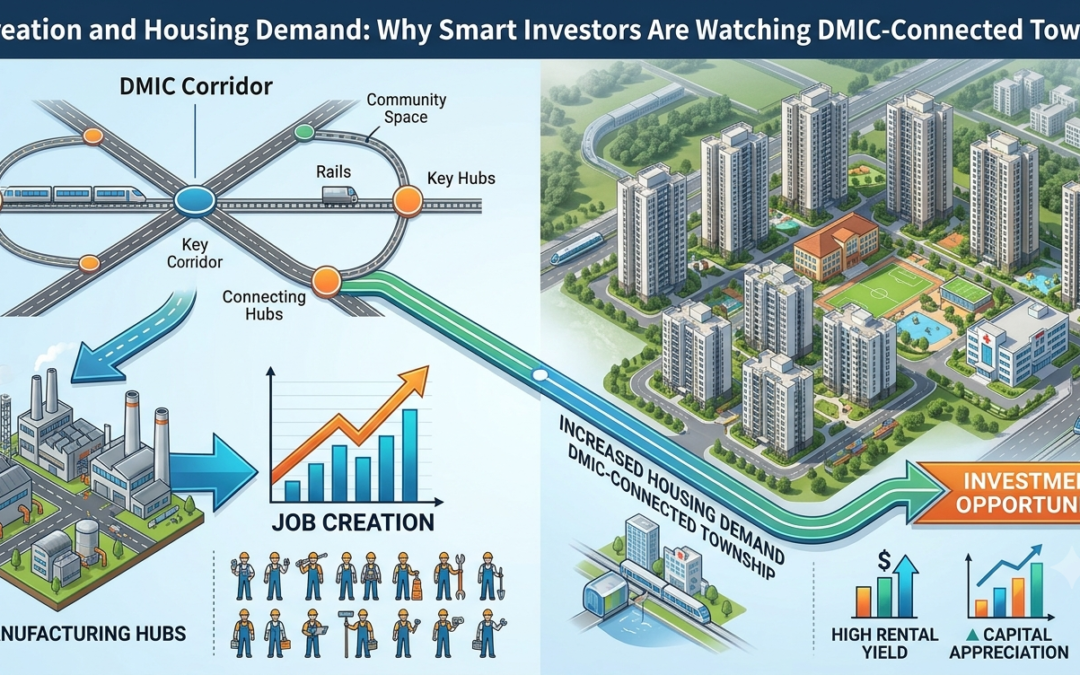
The strongest real estate opportunities often grow around something bigger than buildings: jobs. When a new industrial facility opens, a logistics company expands or a manufacturing unit starts hiring, people begin looking for homes nearby. That simple connection between employment and housing can gradually change an area’s property market.
This is why Investment in industrial townships Greater Noida is attracting attention from investors who want to understand the long-term potential of employment-led development. The region’s connection with the Delhi-Mumbai Industrial Corridor (DMIC), its industrial infrastructure and its growing residential market make it worth examining.
But does industrial growth automatically translate into rental income? Not quite. Investors need to understand where jobs may emerge, which professionals could need housing and whether the available residential supply matches their budgets and preferences.
Let’s look at how DMIC-linked development could influence housing demand and what serious property investors should consider before committing their money.
Why Are Investors Connecting Industrial Growth with Residential Property Demand?
Imagine a manufacturing company setting up a new facility in an industrial township. It hires engineers, technicians, managers, administrative staff and security personnel. A logistics partner brings in more workers. Suppliers and service providers start operating nearby.
Soon, some employees begin searching for rental homes. Others consider buying apartments because they expect to stay in the region for several years. Their families may follow, creating demand for schools, healthcare, shops and other everyday services.
This is how employment-driven housing demand can develop. It doesn’t happen overnight, but it can create a steady market when businesses expand and jobs become more stable.
For investors, this relationship makes Investment in industrial townships Greater Noida an interesting subject. Instead of relying only on future infrastructure announcements or speculative price movements, they can study the economic activity that may bring actual residents into the area.
The important question is not simply whether a township will grow. It is whether people will have practical reasons to live there.
What Makes DMIC Greater Noida an Important Industrial Location?
The Delhi-Mumbai Industrial Corridor is a major industrial development initiative designed to strengthen manufacturing, trade and logistics infrastructure across several states. Greater Noida is one of its important locations.
The Integrated Industrial Township in Greater Noida covers approximately 747 acres and is positioned near the Eastern Peripheral Expressway and Delhi-Howrah railway line. It also benefits from proximity to the Dadri logistics hub and Boraki transport hub. According to the National Industrial Corridor Development Corporation, the township focuses on sectors such as white goods, electronics, mobile manufacturing, biotechnology, research and development, and general engineering.
Why should residential investors care about these industries?
Because each sector requires people with different skills. An electronics manufacturing unit may need production staff and quality-control engineers. A logistics business may employ warehouse supervisors, transport coordinators and operations teams. Research facilities can attract technical professionals and specialised workers.
This mix can create different housing requirements, from affordable rental accommodation to larger family apartments.
The wider DMIC townships investment story is therefore not limited to industrial land. It also involves the residential and commercial services needed to support a working population.
How Can DMIC Job Creation Influence Housing Demand?
Industrial development creates employment through several channels. Some jobs appear directly inside factories and industrial facilities, while others emerge around them.
Let’s break down the connection.
1. Direct Employment in Manufacturing
Manufacturing is one of the key focus areas of the Greater Noida industrial township. Companies in electronics, white goods and engineering need production workers, technicians, supervisors, quality-control teams and managers.
When these businesses expand, they may attract employees from nearby cities as well as people relocating from other regions.
Not every employee will purchase a property. Many will prefer rented accommodation, particularly when they are new to the area or unsure how long they will remain there.
For landlords, this creates a potential tenant segment worth studying.
2. Jobs in Logistics and Warehousing
Industrial growth depends on moving goods efficiently. Raw materials need to reach factories, finished products need to move to markets and warehouses need staff to manage storage and distribution.
The Dadri logistics ecosystem and the wider freight infrastructure can support activities such as transportation, warehousing, inventory management and supply-chain operations.
These businesses can generate employment beyond factory premises. Drivers, warehouse operators, fleet managers, accountants and administrative professionals may all need accommodation within commuting distance.
This is one reason DMIC job creation matters to residential investors. The employment impact can extend beyond the industrial unit itself.
3. Supporting Businesses and Local Services
A growing workforce also needs everyday services. Restaurants, grocery stores, clinics, transport operators, repair shops, educational centres and other businesses may see opportunities as the local population increases.
These supporting activities can create additional jobs and attract more residents.
Think of it as a chain reaction. One industrial investment may support several smaller businesses, and those businesses may bring another group of workers into the area.
The resulting employment-driven housing demand can develop across different price segments rather than concentrating only on premium apartments.
Why Are Smart Investors Watching DMIC-Connected Townships?
A residential property near an employment centre can offer a practical advantage: tenants may prefer shorter commutes.
For example, an employee working in an industrial or logistics zone may compare two rental homes. One offers a slightly larger living room but requires a long daily journey. The other is closer to work and has convenient access to shops and transport.
The second option may be more attractive, even if it is not the biggest apartment in the neighbourhood.
This is where Investment in industrial townships Greater Noida deserves attention. Investors can examine whether the surrounding employment ecosystem is likely to create a real tenant base.
There are several reasons why this location is worth monitoring:
- Industrial and manufacturing activity can support employment.
- Freight and transport infrastructure can attract logistics businesses.
- The wider Greater Noida region has educational and healthcare institutions.
- Expressway connections can support travel between employment and residential areas.
- Residential development can provide accommodation for workers and families.
However, these factors should be treated as demand drivers to investigate, not guarantees of rental returns or property appreciation.
What Role Could Godrej DMIC Play in the Residential Market?
Residential developments can become part of the housing supply needed by a growing employment region. One project attracting attention in this context is Godrej DMIC in Greater Noida.
The Real Estate Labs project page presents it as a residential development in the DMIC influence zone, with 2 BHK, 3 BHK and 4 BHK configurations. It also lists lifestyle facilities, landscaped areas and connectivity details. These are marketing-page descriptions and should be checked against the developer’s official brochure, approved plans and registration documents before buyers rely on them.
For investors, the key question is how a residential project fits into the wider local market.
A development with smaller apartments may appeal to young professionals or smaller households. Larger configurations may attract families and senior employees who prefer more living space.
The tenant profile will depend on factors such as:
- Distance from actual workplaces.
- Daily travel options.
- Apartment size and monthly rent.
- Nearby schools, hospitals and shopping facilities.
- Maintenance charges and community facilities.
- Availability of competing rental properties.
Investors considering DMIC Greater Noida property should compare the project’s likely tenant profile with the type of employment developing in the surrounding region.
A premium apartment may look impressive, but if the local workforce mainly needs affordable rental housing, the landlord could face a mismatch between supply and demand.
Which Property Types Could Benefit from Employment Growth?
Not every property type responds to industrial growth in the same way. The right investment depends on the expected tenant profile, available infrastructure and entry price.
1. Compact Residential Apartments
Smaller apartments may appeal to single professionals, newly married couples and employees who have relocated for work.
Their main advantage is affordability compared with larger homes. If the local rental market supports them, they may attract tenants looking for convenient accommodation close to employment areas.
2. Family-Sized Apartments
Engineers, managers and other professionals who relocate with their families may prefer 2 BHK, 3 BHK or larger homes.
These tenants may value schools, healthcare, security, parking and recreational facilities. They may also prefer longer rental arrangements if their employment is stable.
3. Plotted Developments
Some buyers prefer plots because they want flexibility over construction and future use. However, plotted investments require careful checks of land title, permitted use, development approvals, road access and utility connections.
A plot near an industrial area does not automatically become a good residential investment. Its value depends on planning rules and actual demand.
4. Commercial and Mixed-Use Property
Employment centres can support demand for shops, food outlets, offices and local services.
Yet commercial investments need their own analysis. Footfall, frontage, tenant mix, access and competing supply can matter more than the general growth story of the township.
For Investment in industrial townships Greater Noida, choosing the right property category is just as important as choosing the location.
How Should Investors Evaluate Rental Yield Potential?
Rental yield is one of the most important measures for investors looking for regular income.
The basic formula is:
Gross Rental Yield = (Annual Rental Income ÷ Total Property Cost) × 100
For example, suppose an apartment costs ₹1 crore and earns ₹30,000 in monthly rent.
Annual rental income = ₹30,000 × 12 = ₹3.6 lakh.
Gross rental yield = ₹3.6 lakh ÷ ₹1 crore × 100 = 3.6%.
But this is only the gross figure. The actual return will be lower after accounting for maintenance, property tax, repairs, insurance, vacancy periods and other expenses.
Investors should also consider the full purchase cost, including registration charges, taxes and any additional fees.
Before making an investment, compare:
- Current rents in nearby residential societies.
- Similar apartments available for rent.
- Average time properties remain vacant.
- Monthly maintenance expenses.
- Tenant demand across different apartment sizes.
- The likely cost of furnishing and repairs.
A property that appears affordable may deliver a weaker return if it remains vacant for several months. On the other hand, a slightly more expensive apartment in a better-connected location may attract tenants more consistently.
That is why DMIC townships investment should be assessed using real rental comparisons rather than projected figures alone.
What Connectivity Factors Can Support Residential Demand?
Employment and connectivity work together. People may accept a longer commute if transport is reliable, but most tenants still value convenience.
Greater Noida’s industrial township benefits from proximity to the Eastern Peripheral Expressway, Delhi-Howrah railway line, Dadri logistics hub and Boraki transport hub. These connections are important to the wider industrial and logistics ecosystem.
For residential investors, the practical questions are slightly different:
- How long does it take to reach major employment areas?
- Are public transport options available?
- Can residents access schools and hospitals easily?
- Are daily shopping and food options nearby?
- Are the connecting roads operational or still proposed?
- How does traffic behave during working hours?
Don’t rely only on distance figures printed in a property advertisement. Drive the route if possible, check peak-hour travel times and look at the condition of the surrounding roads.
The value of DMIC Greater Noida property will depend partly on how easily residents can connect their homes with workplaces and everyday services.
What Risks Should High-Net-Worth and Institutional Investors Consider?
Industrial growth can create attractive opportunities, but experienced investors know that a promising location is only one part of the calculation.
Here are some risks worth examining.
1. Job creation may take time: Announced industrial investment does not always translate into immediate hiring. Businesses may take years to become fully operational.
2. Employment may not match premium housing supply: Industrial workers, technicians and senior managers have different budgets. Investors should identify which tenant segment a project is designed to serve.
3. Rental demand can be uneven: A location may attract strong interest in one apartment category but weaker demand in another.
4. Infrastructure timelines can change: Proposed roads, transport links and public facilities should not be treated as completed infrastructure.
5. Too much competing supply can affect rents: If several projects launch around the same time, landlords may compete for the same tenants.
6. Legal and approval checks remain essential: Verify title, land use, building approvals, RERA registration where applicable, possession commitments and the developer’s track record.
For institutional investors, due diligence should also include project-level cash-flow modelling, exit options, operating expenses and downside scenarios.
A disciplined approach to Investment in industrial townships Greater Noida means testing both the optimistic case and the less exciting one.
How Can Investors Build a Long-Term Strategy Around DMIC Growth?
A sensible investment strategy begins with the employment map, not the property brochure.
First, identify the industrial and logistics areas that are operational or have credible development progress. Next, study the companies operating there and the types of jobs they generate.
Then examine nearby residential locations. Compare travel times, rents, apartment sizes and the amount of competing supply.
Investors with larger budgets may also consider diversifying across property types or locations rather than placing all their capital into one project. Institutional buyers can evaluate residential portfolios, rental housing opportunities and commercial assets separately.
For individual buyers, the strategy may be simpler: choose a property that suits a realistic tenant profile, has clear legal documentation and can be held comfortably over the expected investment period.
The wider DMIC job creation story may support housing demand, but the timing and scale will vary across sectors and locations.
Conclusion: Can Employment-Led Growth Create a Stronger Residential Market?
Industrial townships can influence housing markets by bringing businesses, workers and supporting services into the same region. Greater Noida’s position within the DMIC ecosystem makes it an area worth watching, particularly for investors interested in the connection between economic activity and residential demand.
Still, a growing industrial zone does not make every nearby apartment or plot a good investment. Rental yield depends on purchase price, tenant demand, property type, connectivity, vacancy and operating costs.
For serious investors, Investment in industrial townships Greater Noida should begin with one practical question: who will rent or buy this property, and why would they choose this location?
When the answer is supported by real employment activity, sensible pricing and verified infrastructure, the opportunity becomes much easier to evaluate. Follow the jobs, study the tenants and let the numbers—not the excitement—guide the final decision.
FAQs
1. How does DMIC job creation affect residential property demand?
Industrial and logistics businesses can create jobs for workers, technicians, managers and support staff. Some employees may look for rental homes or purchase properties near their workplaces, potentially increasing local housing demand.
2. Why are investors interested in industrial townships in Greater Noida?
Greater Noida’s DMIC-linked infrastructure, manufacturing focus and logistics connectivity make it an area worth monitoring. Investors are studying whether future business activity can support employment, rental demand and long-term residential growth.
3. What industries are planned for the DMIC Integrated Industrial Township in Greater Noida?
NICDC identifies white goods, electronics, mobile manufacturing, biotechnology, research and development, and general engineering among the township’s focus sectors.
4. Can residential properties near industrial townships generate rental income?
They may attract tenants working in nearby factories, logistics facilities and supporting businesses. However, rental income depends on the property’s price, location, apartment size, tenant demand and competing supply.
5. Is Godrej DMIC worth considering for property investors?
Godrej DMIC is a residential development presented in the DMIC influence zone. Investors should examine its official approvals, pricing, apartment details, construction status and rental comparables before making a decision.
6. How can investors calculate rental yield in Greater Noida?
Divide the annual rental income by the total property cost and multiply by 100. For a more realistic estimate, also account for maintenance, taxes, repairs, vacancy periods and other ownership expenses.
7. What should institutional investors check before investing in DMIC-linked property?
They should evaluate employment growth, tenant demand, rental comparables, infrastructure progress, competing supply, legal approvals, operating costs and exit opportunities. Scenario-based financial modelling can help test the investment’s resilience.