
Imagine buying a property in an area that looks quiet today but could become an important business and employment destination over the next decade. Would you consider it? Many long-term property investors follow this approach. They look beyond current development and study where roads, industrial facilities, logistics hubs and employment centres are planned.
One major infrastructure initiative attracting this kind of attention is the Delhi-Mumbai Industrial Corridor (DMIC). It is designed to improve industrial activity, freight movement and economic connectivity between important regions of India. Its influence also reaches parts of the Delhi-NCR property market, including Greater Noida.
But does an industrial corridor automatically make nearby property more expensive? Not quite. Infrastructure can create opportunities, but actual property value depends on several factors, including employment, connectivity, local demand and project delivery.
Understanding the DMIC project impact on Greater Noida real estate can help homebuyers, commercial property owners and investors make better-informed decisions.
What Is the Delhi-Mumbai Industrial Corridor and Why Does It Matter for Real Estate?
The Delhi-Mumbai Industrial Corridor is a major industrial development initiative built around the Western Dedicated Freight Corridor (WDFC). It covers an approximately 1,504-kilometre route connecting the Delhi-NCR region with the Jawaharlal Nehru Port near Mumbai.
The corridor passes through several states, including Uttar Pradesh, Haryana, Rajasthan, Gujarat and Maharashtra. Its purpose is to support manufacturing, logistics, trade and industrial development through planned infrastructure and investment destinations.
The project is not simply a highway connecting two major cities. Think of it as a larger economic network. Freight transportation, industrial townships, logistics facilities and supporting infrastructure are all part of the bigger picture.
The National Industrial Corridor Development Corporation (NICDC) identifies the Integrated Industrial Township in Greater Noida as one of the developed greenfield industrial smart cities under the DMIC programme. Uttar Pradesh also identifies projects such as the Dadri-Noida-Ghaziabad Investment Region and the Integrated Multi-Modal Logistics Hub near Dadri.
Why does this matter to property buyers? Industrial development can attract businesses, create jobs and increase demand for housing, shops, offices and warehouses. These changes may influence the DMIC project impact on Greater Noida real estate over time.
How Can DMIC Influence Real Estate Prices in Greater Noida?
The connection between industrial infrastructure and property prices usually develops gradually. A new industrial facility does not instantly increase the value of every nearby apartment or plot.
Instead, several changes can happen over time.
1. Employment Growth Can Increase Housing Demand
Industrial corridors aim to attract manufacturing companies, logistics operators, suppliers and other businesses. When these businesses establish operations, they need employees.
Some workers may relocate from other cities, while others may move closer to their workplaces. Managers, technical professionals, business owners and support staff can all contribute to housing demand.
This creates opportunities for residential property markets. People working in industrial and commercial centres often prefer homes that reduce commuting time and offer access to schools, hospitals and everyday services.
For investors, this is an important part of the Delhi-Mumbai Industrial Corridor real estate impact. Employment growth can support demand for rental apartments and family homes, provided the location offers practical connectivity and suitable housing.
However, investors should look for actual business activity rather than relying only on projected job numbers. Announced investment and operational employment are two different things.
2. Better Freight Connectivity Can Support Commercial Property
Businesses depend on efficient transportation. Manufacturers need to move raw materials and finished goods, while logistics companies require access to roads, freight terminals and distribution centres.
The WDFC is important because it supports freight movement between major industrial and commercial regions. Dadri is particularly relevant to the Delhi-NCR end of the corridor.
Uttar Pradesh’s DMIC development plans include a logistics hub and transport hub in the Dadri-Greater Noida region. Such facilities can support warehousing, distribution, transport and related commercial activity as they progress.
This is where the DMIC project impact on Greater Noida real estate becomes relevant for commercial property holders.
Demand may increase for:
- Warehouses and storage facilities.
- Industrial plots and factory spaces.
- Transport and logistics offices.
- Small commercial units serving employees.
- Retail spaces near established residential and employment areas.
Still, not every commercial property benefits equally. A warehouse needs suitable truck access and zoning, while a retail shop depends on customer movement and local spending. The right property type matters just as much as the location.
3. Infrastructure Can Improve the Appeal of Nearby Residential Locations
People rarely choose a home based on one factor alone. They consider the distance to work, road conditions, schools, hospitals, shopping facilities and public transport.
Industrial development can encourage investment in supporting infrastructure. Better roads, improved freight connections and planned urban facilities may make certain locations more practical for residents and businesses.
For household buyers, this can improve everyday convenience. For landlords, it may help attract tenants who work in nearby employment centres.
This is one reason investors study the industrial corridor impact on property values before selecting a location. They want to understand whether infrastructure improvements could lead to stronger end-user demand.
However, a proposed road or transport facility should not be treated as an operational one. Always check its current status, expected completion timeline and actual distance from the property.
What Does Godrej DMIC Tell Buyers About Residential Development?
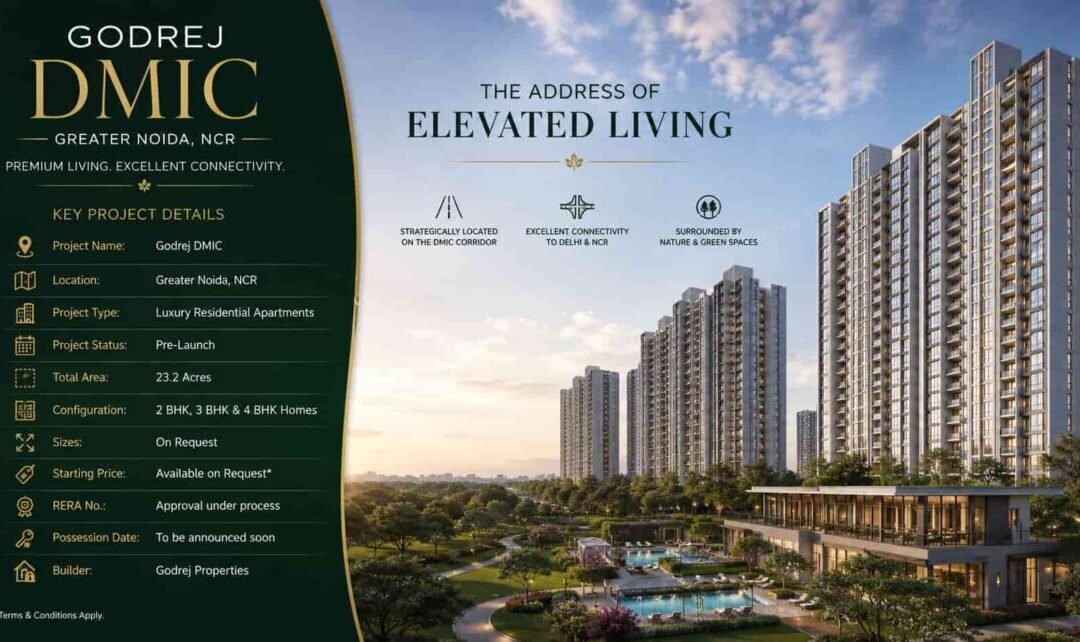
A useful way to understand how developers are positioning residential opportunities around the corridor is to examine the Godrej DMIC listing on Real Estate Labs.
The listing presents Godrej DMIC as an integrated residential township in the DMIC influence zone of Greater Noida. It describes 2 BHK, 3 BHK and 4 BHK apartment configurations, with advertised sizes ranging from approximately 1,050 to 2,350 sq. ft.
It also lists lifestyle facilities such as a clubhouse, swimming pools, sports courts, jogging tracks, landscaped areas, fitness spaces and security arrangements.
The listed indicative prices range from approximately ₹90 lakh for certain 2 BHK configurations to ₹2.50 crore for selected 4 BHK residences. These are listing figures, not guaranteed transaction prices or an independent valuation. Buyers should request the latest official cost sheet and verify availability before making comparisons.
The page also mentions retail shops, restaurants and studio apartments with prices available on request. This is relevant because a mixed-use development can serve different property requirements, although buyers should verify the approved use and availability of each category.
For someone researching the DMIC project impact on Greater Noida real estate, this listing illustrates how residential and commercial property opportunities are marketed around the corridor’s broader development story.
There is an important distinction, though: the presence of a project marketed as being in a DMIC influence zone does not mean that the project itself is an official DMIC industrial facility. Nor does it establish a guaranteed price benefit from the corridor.
Before booking, independently verify the developer, project identity, land details, exact location, approvals and phase-wise UP-RERA registration. Also confirm whether the project status shown in the listing matches the latest official records.
Which Areas and Property Types Could Benefit from DMIC Development?
The DMIC is a multi-state initiative, so its influence is not limited to one city or one residential market.
Its industrial nodes and supporting projects cover different locations, each with its own economic role. In Uttar Pradesh, the Dadri-Noida-Ghaziabad region and Greater Noida’s integrated industrial township are particularly relevant to the Delhi-NCR market.
The DMIC project cities and land rates should therefore be studied individually. A location near an operational industrial facility may have a different demand profile from one that is only included in a long-term development proposal.
Here are some property categories investors may consider:
Residential apartments: These may attract professionals and families working in nearby industrial, logistics and business areas. Rental demand will depend on actual employment and access to daily facilities.
Residential plots: Buyers interested in residential plots near Delhi-Mumbai Industrial Corridor locations should check land-use permissions, title documents, road access and approved development plans. A plot near an industrial area is not automatically suitable for residential construction.
Commercial shops and offices: These properties may benefit when nearby residential populations and business activity increase. Visibility, parking, footfall and access are important considerations.
Warehouses and industrial properties: These require more specialised research. Zoning, road width, truck movement, power supply, fire approvals and industrial permissions can strongly affect their usability.
Greater Noida deserves attention because government plans identify industrial and logistics projects in its wider region. However, investors should not assume that every sector or locality will receive the same benefit.
Do DMIC Projects Automatically Increase Property Prices?
This is probably the most important question for anyone considering a long-term purchase.
The short answer is no.
Infrastructure can support property demand, but prices also depend on supply, buyer affordability, construction quality, financing conditions, local services and the wider economy.
For example, an area may receive a new industrial facility, but if it also has a large supply of unsold apartments, prices may not rise as quickly as investors expect.
Similarly, a plot may be located near a proposed logistics hub but remain difficult to develop because of land-use restrictions or limited road access.
The DMIC property prices discussion should therefore include more than distance from an industrial corridor. Investors should compare:
- Current transaction prices rather than relying only on advertised rates.
- Rental demand and actual occupancy.
- Availability of completed infrastructure.
- New residential and commercial supply.
- Local employment and business activity.
- Project approvals and construction progress.
- Access to schools, hospitals and public transport.
A realistic assessment of the DMIC project impact on Greater Noida real estate should separate confirmed developments from future expectations.
What Should Long-Term Investors Check Before Buying Near DMIC?
Buying property for capital appreciation requires patience and careful research. A location may look promising on a map, but the numbers must make sense.
Use the following checklist before investing.
1. Verify the exact location
Check the property’s distance from the relevant industrial township, freight facility or logistics hub. Measure the actual road route rather than relying on a straight-line distance.
2. Check infrastructure progress
Find out whether a facility is operational, under construction, approved or merely proposed. These stages carry very different levels of certainty.
3. Review land and project documents
For residential projects, verify UP-RERA registration, approved plans, title information and the relevant project phase. For plots and commercial land, check zoning and permitted use.
4. Compare real market prices
Look at recent registered transactions where available. Compare similar properties in the same locality rather than using a premium project advertisement as the market benchmark.
5. Understand the rental market
Ask whether nearby businesses have started operations and whether employees are actually looking for accommodation. A property with realistic rental demand may be more useful than one relying entirely on future appreciation.
6. Calculate the complete investment cost
Include registration, stamp duty, maintenance, taxes, loan interest, fit-out costs and other charges. These expenses can affect your eventual return.
7. Keep a long investment horizon
Industrial development takes time. Investors should avoid depending on quick resale or assuming that every infrastructure announcement will translate into immediate price growth.
These checks make real estate investment near DMIC more evidence-based and reduce the risk of buying purely on promotional claims.
Is Greater Noida a Long-Term Real Estate Opportunity?
Greater Noida has an important place in the wider Delhi-NCR development story because of its industrial, residential, educational and transport-related infrastructure.
The DMIC programme adds another layer to this story through the planned industrial township and logistics-related developments around Dadri. These initiatives could support economic activity and create demand for different types of property over time.
For households, the key question is whether a location offers comfortable living conditions and practical connectivity. For commercial property holders, it is whether businesses and customers can reach the property easily. For investors, it is whether the purchase price is reasonable compared with the area’s current demand and future development prospects.
The DMIC project impact on Greater Noida real estate may become more visible as industrial and logistics facilities develop and attract business activity. But the pace and scale of that impact will vary across locations.
The strongest investment decisions usually come from combining infrastructure research with local market knowledge. Do not buy simply because a project name includes DMIC. Understand what is being built, where it is being built and how it could create real demand.
Conclusion
The Delhi-Mumbai Industrial Corridor is an important initiative for India’s industrial and logistics development. Its connection with the Western Dedicated Freight Corridor, along with industrial and logistics projects around Dadri and Greater Noida, gives the region a long-term economic development opportunity.
For property investors, the opportunity lies in understanding how industrial activity may influence employment, housing demand, commercial requirements and land use.
The DMIC project impact on Greater Noida real estate should be viewed as a potential long-term demand driver, not a promise of guaranteed appreciation. Study operational infrastructure, verify project documents, compare actual prices and choose a property that has a clear end-user or business purpose.
A good investment is not simply about reaching a location before everyone else. It is about understanding why people and businesses may want to be there in the first place.
Frequently Asked Questions
1. What is the Delhi-Mumbai Industrial Corridor?
The Delhi-Mumbai Industrial Corridor is a major industrial development initiative built around the Western Dedicated Freight Corridor. It aims to support manufacturing, logistics, trade and planned industrial development across several states between Delhi-NCR and Mumbai.
2. How can DMIC affect property prices in Greater Noida?
DMIC-related industrial and logistics development may create employment and business activity, which can support demand for nearby housing, commercial spaces and warehouses. However, actual property prices will also depend on local supply, infrastructure progress and buyer demand.
3. Is Greater Noida part of the DMIC project?
Yes. The Integrated Industrial Township in Greater Noida is identified as a DMIC greenfield industrial smart city. Uttar Pradesh’s plans also identify logistics and investment-related projects around Dadri and Greater Noida.
4. Is Godrej DMIC a good option for property buyers?
The Real Estate Labs listing describes Godrej DMIC as a residential township offering 2 BHK, 3 BHK and 4 BHK configurations, along with lifestyle amenities. Buyers should independently verify the project’s exact location, developer details, approvals, UP-RERA registration, construction status and current pricing before booking.
5. Does buying property near DMIC guarantee capital appreciation?
No. Industrial development may support long-term demand, but it cannot guarantee property price growth. Investors should assess current market rates, infrastructure progress, rental demand, property documents and the overall investment cost before purchasing.